Photo quality reflects business credibility because customers form trust judgments in seconds, using image clarity and authenticity as their primary evidence of your professionalism. Research from the Nielsen Norman Group confirms that users focus on real people photos but ignore generic stock images entirely, treating them as visual noise. Studies on eBay auctions, Airbnb listings, and e-commerce platforms consistently show that image quality shapes purchasing decisions before price, reviews, or descriptions enter the picture. The term "visual credibility" captures this dynamic precisely: your photos are not decoration. They are inspectable proof of who you are as a business.
Why photo quality reflects business credibility in every market
High-quality photos function as trust signals, and trust signals reduce the risk a buyer perceives when they cannot physically inspect your product or property. This mechanism is well-documented across industries. A 2020 Airbnb-focused study found that host photo quality directly increased perceived trustworthiness and allowed hosts to charge higher rates. That is not a coincidence. It reflects a basic psychological reality: when buyers cannot touch, smell, or visit what you are selling, your images become the product.
The concept researchers call "product fit uncertainty" explains the flip side. A 2014 study found that unclear visuals reduce purchases and increase product returns, because buyers who cannot confidently assess a product before buying will either skip the purchase or regret it afterward. Poor photos do not just fail to impress. They actively cost you sales and create post-purchase friction.
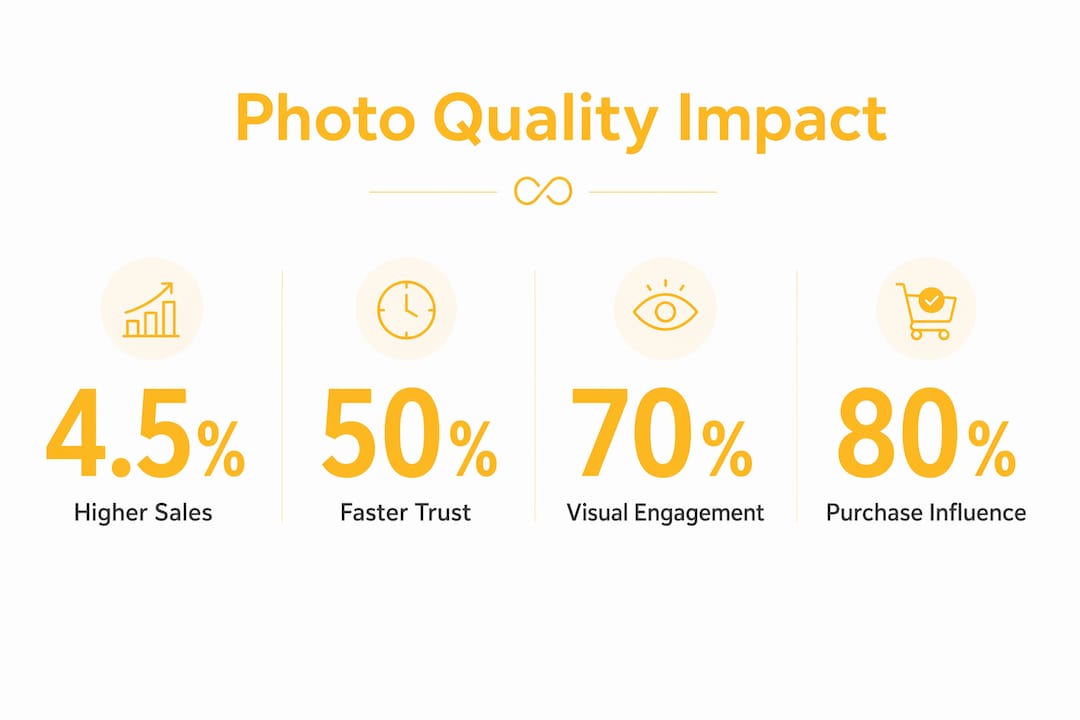
eBay data adds a concrete number to this picture. Listings that follow photo quality standards are 4.5% more likely to sell. That figure compounds across hundreds of listings and thousands of transactions. For a business owner, that percentage represents real revenue left on the table every time a blurry or poorly lit photo goes live.
| Impact area | What the research shows |
|---|---|
| Purchase likelihood | eBay listings with quality photos sell 4.5% more often |
| Perceived trust | Airbnb hosts with quality photos earn higher trust ratings and rates |
| Returns and regret | Unclear product photos increase return rates due to unmet expectations |
| Attention and credibility | Real photos hold user attention; stock photos are visually ignored |
Pro Tip: Shoot your photos in natural light near a window or outdoors. Lighting is the single fastest upgrade you can make without any equipment investment.
Do real photos outperform stock images for building trust?
Yes, and the gap is larger than most business owners expect. The Nielsen Norman Group's eye-tracking research shows that website visitors focus their attention on photos of real people and real environments, while generic stock images receive almost no visual engagement. Visitors do not consciously decide to distrust stock photos. Their eyes simply move past them.
The academic explanation for this comes from warranting theory, which holds that credibility depends on signals that are hard to fake. A stock photo of a smiling professional costs nothing and signals nothing about your actual business. A photo of your real team, your real workspace, or your real product in context is specific and inspectable. It carries weight precisely because it is harder to fabricate convincingly.
Research from eBay and the secondhand marketplace Letgo reinforces this. A 2015 eBay study of 217 auctions found that listings with actual product photos attracted more bidders and sold at higher prices than those using stock or generic images. Buyers responded to the specificity of real photos as evidence of a real, accountable seller.
Here is what effective authentic business photography looks like in practice:
- Team photos: Real faces with names and roles attached. Not posed stock photography, but candid or semi-formal shots that show your actual people.
- Process photos: Images of your work in progress. A contractor photographing a renovation mid-project. A baker photographing dough being shaped. These signal competence and transparency.
- Location photos: Your actual office, storefront, or property. Context matters. Buyers want to know where you operate.
- Product-in-use photos: Show your product being used by real customers or in real settings. This closes the gap between what buyers imagine and what they will actually receive.
Each of these photo types functions as a warrant: inspectable evidence that your business is real, your product is as described, and your claims are verifiable.
How does image realism affect customer trust?
Image realism is a dominant driver of trust formation, and inconsistencies in visual content can cause trust to collapse abruptly. A 2026 paper published in Frontiers in Psychology applied the Stimulus-Organism-Response (S-O-R) psychological framework to AI-generated video content and found that perceived realism predicts user trust directly. When visual anomalies appear, such as distorted backgrounds, unnatural lighting, or physically impossible details, trust does not decline gradually. It breaks.
This finding has direct implications for businesses using AI-enhanced photography. AI tools that correct exposure, sharpen detail, or replace a gray sky with a blue one can improve photo quality without harming realism. But AI tools that generate content that was never there, or that introduce visual artifacts, create exactly the kind of inconsistency that triggers distrust. The line between enhancement and fabrication matters enormously.
A parallel development in digital media is the emergence of C2PA provenance labels, a technical standard that embeds metadata into images to show their origin and editing history. A 2026 ICWSM/AAAI study with 6,114 participants found that provenance metadata increased trust in digital news images across Western countries. The mechanism is transparency: when viewers can inspect where an image came from and how it was processed, their confidence in its authenticity rises.
| Approach | Trust effect | Risk level |
|---|---|---|
| Real, unedited photos | High trust, high authenticity | Low |
| AI-enhanced real photos | High trust if realism preserved | Low to medium |
| AI-generated content | Trust depends entirely on realism | High |
| Stock photos | Low engagement, low credibility signal | Medium |
Pro Tip: When using AI photo enhancement, check the final image for visual anomalies around edges, reflections, and shadows. These are the areas where AI artifacts appear most often and where buyers look most closely.
Practical steps to improve your business photos right now
Improving your visual credibility does not require a professional photographer on retainer. It requires consistency, context, and attention to a few technical basics.
-
Shoot in good light. Natural light from a window or an overcast outdoor setting produces even, flattering results without equipment. Avoid overhead fluorescent lighting, which creates harsh shadows and unflattering color casts.
-
Keep your photo style consistent. A 2026 UX study found that photo coherence ranks second only to price as a trust factor in online listings. Inconsistent photos, mixing different angles, lighting conditions, and editing styles, reduce buyer confidence even when individual photos are technically good.
-
Optimize for your Google Business Profile. Businesses with complete, high-quality photo sets on Google Business Profile receive significantly more clicks and direction requests than those with sparse or low-quality images. Your profile photos are often the first visual impression a local customer sees.
-
Use AI enhancement tools carefully. Tools like Proofe's AI photo enhancer can correct exposure, sharpen detail, and improve color balance without altering the fundamental reality of what was photographed. This is the right use of AI: improving what is real, not replacing it.
-
Audit your existing photos. Pull up your website, your listings, and your social profiles. Ask honestly: do these photos look like a business you would trust with your money? If the answer is uncertain, that uncertainty is what your customers feel too.
-
Show context, not just the subject. A photo of a product against a white background tells buyers what it looks like. A photo of that product in use tells them what it does for them. Both have a place, but context photos build emotional connection and reduce uncertainty simultaneously.
Pro Tip: Before publishing any photo, view it at the size it will appear on a mobile screen. Most of your customers will see it that way first, and compression artifacts that are invisible on desktop become obvious on mobile.
Key takeaways
Photo quality is a direct, measurable driver of business credibility because it functions as inspectable evidence of your professionalism, authenticity, and commitment to the customer experience.
| Point | Details |
|---|---|
| Photos are trust signals | Buyers use image quality to assess seller reliability before reading descriptions or reviews. |
| Real photos outperform stock | Authentic images reduce perceived risk and hold user attention; stock photos are visually ignored. |
| Realism determines AI trust | AI-enhanced photos build credibility only when visual consistency and realism are preserved. |
| Consistency compounds trust | Coherent photo sets across listings and profiles rank second only to price as a trust driver. |
| Provenance adds transparency | Metadata showing image origin increases viewer trust beyond aesthetics alone. |
What I have learned from watching businesses get this wrong
Richard here. After years of watching businesses invest in everything except their photos, I have one observation that I keep coming back to: most business owners treat photography as a finishing touch rather than a foundation.
The businesses that struggle with credibility online almost always have the same problem. Their photos are either generic stock images that could belong to any company, or they are real photos shot in poor light with no consistency across their platforms. Neither signals professionalism. Both signal that the business did not think the customer's first impression was worth the effort.
What I find most counterintuitive is that buyers are not consciously critiquing your photography. They are making a gut-level judgment about whether you are trustworthy, and your photos are the primary input for that judgment. A blurry photo does not just look bad. It reads as carelessness. And carelessness in your marketing suggests carelessness in your product or service.
The research on warranting theory changed how I think about this. Your photos are not just visuals. They are evidence. Specific, real, inspectable evidence that you are who you say you are. Stock photos fail not because they look bad, but because they provide no evidence at all. Anyone can buy the same image. No one else has your actual team, your actual space, your actual product.
My recommendation: treat your photo library as a business asset with the same seriousness you give your pricing or your customer service. Audit it quarterly. Replace anything that looks inconsistent or outdated. And when you use AI tools to enhance your images, use them to improve reality, not to replace it.
— Richard
How Proofe helps you build credibility through better photos
If you are a real estate agent, property manager, or homeowner, the gap between your current listing photos and professional-quality images is smaller than you think.
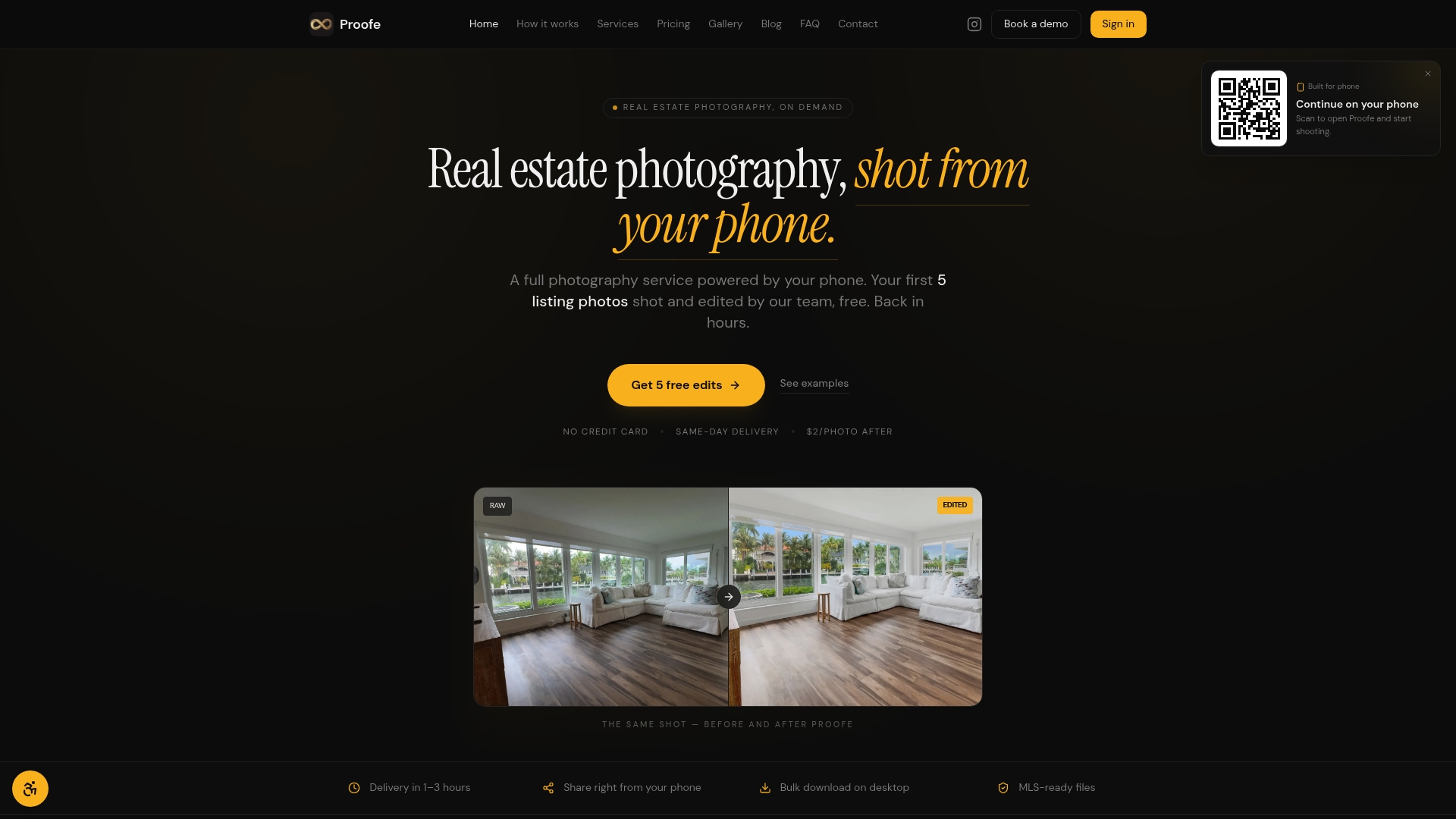
Proofe lets you shoot listing photos directly from your smartphone, then uses AI enhancement to deliver MLS-ready files the same day. The process is three steps: shoot, enhance, download. No expensive equipment. No scheduling a photographer. No waiting days for edited files. The AI enhancement preserves the realism of your original photos while correcting exposure, color balance, and sharpness. Your first five photos are free at Proofe. Start there, see the difference, and decide for yourself.
FAQ
Why do photo quality and business credibility go together?
Photo quality reflects business credibility because images are the primary inspectable evidence buyers use to assess your professionalism before any direct interaction. Research across eBay, Airbnb, and e-commerce platforms consistently links higher image quality to greater buyer trust and higher conversion rates.
Can poor photos actually reduce sales?
Yes. A 2014 study found that unclear product visuals create "product fit uncertainty," which directly reduces purchase rates and increases product returns. Poor photos do not just fail to attract buyers. They actively push them away.
Are stock photos acceptable for business marketing?
Stock photos are generally ineffective for building credibility. Nielsen Norman Group eye-tracking research shows that users ignore generic stock images on websites, while real photos of people and places hold attention and raise trust perceptions.
How does AI photo enhancement affect credibility?
AI enhancement builds credibility when it improves realism without introducing visual anomalies. Research published in Frontiers in Psychology in 2026 found that perceived realism is the dominant predictor of trust in AI-processed visuals, and that inconsistencies cause trust to collapse quickly.
How many photos does a business listing need to build trust?
Quantity matters less than consistency. A 2026 UX study found that coherent, contextually relevant photo sets rank second only to price as a trust driver in online listings. A small set of consistent, high-quality photos outperforms a large set of mismatched ones.