
Real estate photo delivery is defined as the process of transferring listing images from photographer to agent in a format ready for MLS upload and marketing distribution. The right delivery method directly affects how fast your listing goes live. With 78% of listings using automated scheduling delivering photos the same day, the gap between manual and automated real estate photo delivery options compared across platforms is no longer trivial. This guide breaks down every major method by speed, price, and workflow fit so you can choose with confidence.
1. What are the main real estate photo delivery options compared?
Photo delivery for real estate listings falls into three broad categories: all-in-one platforms, delivery-focused tools, and generic storage solutions. Each serves a different user and workflow.
All-in-one platforms like Aryeo and HDPhotoHub combine booking, editing, delivery, and marketing into a single system. They handle MLS auto-resize, branded client portals, and download controls without any manual setup. These platforms suit photographers and agents who want everything in one place.

Delivery-focused tools like BulkShare prioritize fast, organized file handoff. They skip the business management features but nail the core job: getting the right files to the right person quickly. Many pros layer these on top of scheduling software for a best-of-both-worlds setup.
Generic cloud storage tools like Dropbox and Google Drive are common but carry real limitations. Generic cloud tools lack MLS-specific resizing and file normalization, which causes upload errors and wasted time. They also offer no branding, no expiration controls, and no property-specific organization.
- All-in-one platforms: booking + delivery + marketing in one dashboard
- Delivery-focused tools: fast file handoff, MLS-ready exports, lower cost
- Generic cloud storage: free or cheap, but no MLS prep or branded experience
- Email attachments: size limits make them impractical for full listing batches
- USB drives: physical delivery is not scalable for active agents or photographers
Pro Tip: If you shoot more than five listings per month, a dedicated delivery platform will save you more time than its monthly fee costs.
2. How do pricing models compare for real estate photo delivery?
Pricing for photo delivery systems for properties splits into two main structures: monthly subscriptions and per-listing credits. Your volume determines which one saves you money.
Subscription platforms charge $49–$179 per month and include deep integrations like Zillow Showcase syncing, CRM connections, and branded portals. That monthly fee makes sense if you handle 15 or more listings per month. Below that threshold, you may be paying for features you rarely use.
Per-listing models charge $1.20–$2.00 per property. That flexibility is ideal for part-time agents, solo photographers, or homeowners who only need delivery a few times a year. The cost stays proportional to your actual output.
Rush fees add another layer to consider. Same-day or next-morning delivery typically carries a $50–$150 surcharge on top of standard rates. That cost adds up fast if your workflow regularly requires last-minute turnarounds.
| Pricing model | Cost range | Best for |
|---|---|---|
| Monthly subscription | $49–$179/month | High-volume agents and photography teams |
| Per-listing credits | $1.20–$2.00 per property | Part-time agents, solo photographers |
| Rush delivery add-on | $50–$150 per request | Urgent listings needing same-day turnaround |
| Generic cloud storage | Free to $15/month | Budget-only, low-frequency users |
Pro Tip: Calculate your monthly listing volume before committing to a subscription. If you average fewer than 10 listings per month, per-listing pricing almost always costs less annually.
3. What role does automation play in real estate photo delivery?
Automation is the single biggest factor separating fast delivery from slow delivery. 85% of photo delivery delays come from manual coordination between photographers, agents, and MLS systems. Removing that manual step changes everything.
Triggered workflows work like this: a photographer uploads the final batch, the platform automatically notifies the agent, resizes files to MLS specs, and pushes assets to the listing portal. No email chains. No forgotten attachments. No waiting for someone to remember to hit send.
The time savings are concrete. Automation reduces average post-shoot delivery from days to under an hour on most listings. For a listing that needs to go live before the weekend, that difference is the difference between catching buyers and missing them.
Here is what strong automation looks like in a delivery platform:
- Triggered upload-to-notification workflows with no manual steps
- Automatic MLS resizing to 2048px long edge on every file
- CRM and calendar sync so agents see delivery status in real time
- Expiration dates and download controls built into the client portal
- Marketing asset bundling so floor plans, virtual tours, and photos arrive together
"The ultimate goal of real estate photo delivery platforms is to automate handoffs to eliminate manual delays and improve listing speed-to-market." — US Tech Automations
Platforms without automation force agents to manually download, rename, resize, and re-upload files. That process takes 15–30 minutes per listing. Multiply that across a busy month and you are losing hours that could go toward client relationships.
4. How does file formatting affect MLS upload success?
MLS systems have strict photo requirements, and getting them wrong means failed uploads and delayed listings. Professional delivery platforms handle this automatically. Manual workflows do not.
The standard MLS spec requires images resized to a 2048px long edge, saved as JPEG, and kept under a specific file size. HEIC files from iPhones and PNG exports from editing software both fail these requirements without conversion. A platform that normalizes formats on export removes this friction entirely.
File size matters too. Compressing listing batches from 35MB to 18MB cuts upload time significantly, especially on slower office or field connections. Faster uploads mean listings go live sooner and agents spend less time watching progress bars.
| File preparation task | Manual process | Platform automation |
|---|---|---|
| Resize to 2048px long edge | Done in Lightroom or Photoshop | Automatic on export |
| Convert HEIC or PNG to JPEG | Requires separate software | Handled at upload |
| Compress batch to under 20MB | Manual export settings | Applied by default |
| Rename files for MLS order | Done by hand | Auto-sequenced |
Professional platforms save 10–15 minutes per listing through automated sizing and format standardization. That is not a small number when you are managing 20 listings a month.
5. How does the client experience differ across delivery methods?
The way photos are delivered shapes how professional you look to clients. Generic cloud links and email attachments feel transactional. Branded portals feel like a service.
Branded portals with property-specific folders and download controls give agents and homeowners a clean, organized experience. They log in, see their property, download what they need, and move on. No hunting through shared folders or decoding file names.
Some platforms go further. Delivery platforms can add virtual staging and marketing kits alongside the standard photo package. That means agents receive a complete marketing bundle in one place rather than assembling assets from multiple sources. For a listing photo editing service that complements your delivery setup, having everything in one portal saves real time.
Client experience also affects retention. Photographers who deliver through branded portals report stronger repeat business because the process feels polished and reliable. A Dropbox link with 47 files named "IMG_0034.jpg" does not create that impression.
6. What are the best delivery options for specific user types?
The right platform depends on your volume, budget, and how much you value integration versus simplicity. There is no single answer, but there are clear patterns.
Solo photographers and part-time agents benefit most from per-listing pricing tools. The cost stays low, the setup is simple, and there is no monthly commitment when listings slow down. BulkShare and HDPhotoHub both serve this segment well.
Active agents and small teams handling 10–20 listings per month get the most from mid-tier subscription platforms. The automation features pay for themselves quickly, and the MLS integration removes the manual prep step entirely.
Large agencies and photography studios need the full stack: booking, delivery, CRM sync, and branded portals. Aryeo fits this profile. Some studios also use Aryeo for delivery alongside Tonomo for business management, running two specialized tools instead of one generalist platform.
Homeowners and Airbnb hosts are a different case. You do not need a monthly subscription for a one-time listing or a seasonal photo refresh. A per-listing service or a mobile-first app like Proofe gives you professional results without the overhead. Airbnb hosts, in particular, benefit from updating photos between seasons. Fresh exterior shots in spring or warm interior lighting in fall can lift booking rates noticeably.
- Solo photographer or part-time agent: use per-listing pricing, keep costs proportional
- Active agent with 10+ monthly listings: choose a subscription platform with MLS sync
- Photography studio or agency: run a delivery platform alongside a business management tool
- Homeowner or Airbnb host: use a mobile app or per-listing service for seasonal updates
Pro Tip: Airbnb hosts should retake exterior photos at the start of each season. Updated images showing current curb appeal and seasonal lighting consistently outperform year-old photos in search results.
Key takeaways
The fastest and most cost-effective real estate photo delivery method combines automated MLS formatting, triggered workflows, and a pricing model matched to your listing volume.
| Point | Details |
|---|---|
| Automation cuts delays sharply | 85% of delivery delays come from manual steps; automated platforms fix this. |
| Pricing model must match volume | Subscriptions ($49–$179/month) suit high volume; per-listing ($1.20–$2.00) suits low volume. |
| File formatting determines upload success | MLS requires 2048px JPEG files; platforms that automate this save 10–15 minutes per listing. |
| Branded portals improve client retention | Organized, property-specific portals feel more professional than generic cloud links. |
| Homeowners and Airbnb hosts need seasonal updates | Refreshing listing photos each season improves visibility and booking performance. |
What I have learned from comparing these platforms
By Richard Lopez
After spending years watching agents and photographers wrestle with delivery workflows, the pattern I keep seeing is this: people choose platforms based on features lists and then get frustrated by the workflow. The feature count does not matter. The handoff does.
The biggest mistake I see is choosing an all-in-one platform because it looks impressive, then using only 20% of its features while paying full price. If you do not need CRM sync or Zillow integration, you are paying for a kitchen you never cook in. A leaner delivery tool paired with whatever scheduling software you already use often works better and costs less.
The second mistake is treating generic cloud storage as a professional solution. Dropbox is fine for internal file storage. It is not a client-facing delivery system. The lack of branding, MLS prep, and organization signals to clients that the process is improvised. That impression sticks.
What I have found actually works: match the tool to the job. Use a delivery-focused platform for the handoff. Use a business management tool for scheduling and invoicing. And if you are a homeowner or Airbnb host who just needs clean, fast photos a few times a year, skip the subscription entirely. A mobile-first service that delivers MLS-ready files without requiring a camera or editing software is the smarter call. The best AI tools for property management in 2026 are built around exactly this kind of task-specific efficiency.
One more thing: do not overlook seasonal photo updates. Agents and Airbnb hosts who refresh their listing images at the start of each season consistently outperform those who do not. The photos you took last October do not represent your property in April. Fresh images are not a luxury. They are a competitive move.
— Richard Lopez
Get listing photos delivered faster with Proofe
If you want same-day delivery without the complexity of a full platform subscription, Proofe is built for exactly that. You shoot with your phone, AI handles the editing, and your MLS-ready photos are ready to download the same day. No camera equipment. No editing software. No waiting.
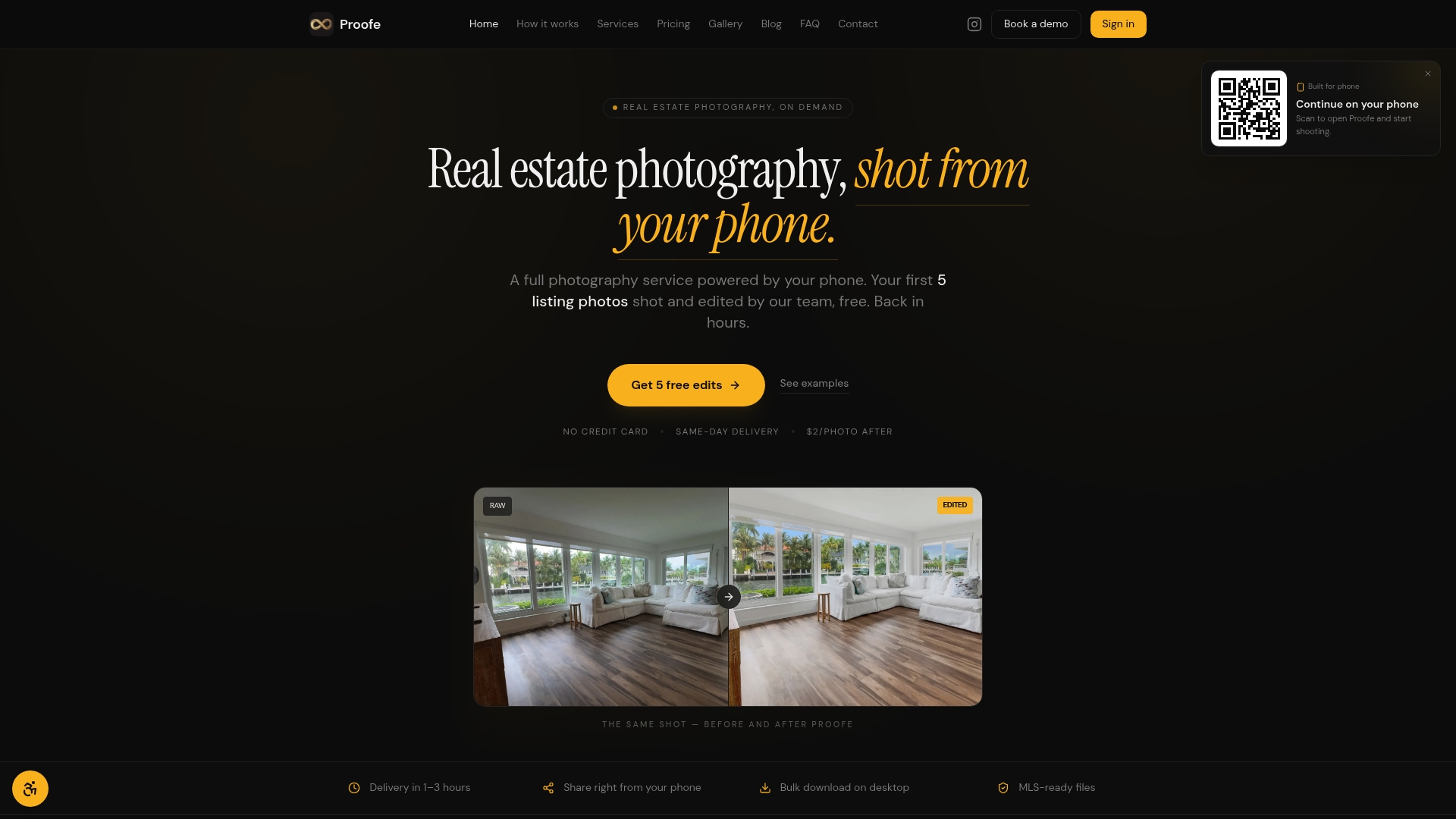
Proofe includes AI photo enhancement, sky replacement, bright room edits, and object removal, all delivered as MLS-ready JPEG files. Your first five photos are free. Whether you are an active agent, a homeowner preparing to sell, or an Airbnb host refreshing seasonal images, Proofe gives you professional results from your phone. Start for free at Proofe and see the difference same-day delivery makes.
FAQ
What is the standard turnaround time for real estate photo delivery?
Standard turnaround is 24 hours for photo-only packages and 3–5 business days for packages that include edited video. Rush delivery typically adds $50–$150 to the cost.
Which delivery method works best for MLS uploads?
Dedicated delivery platforms that automate resizing to 2048px and convert files to JPEG work best. Generic cloud storage lacks MLS-specific formatting, which causes upload errors and delays.
Is a subscription or per-listing pricing better for agents?
Subscription pricing suits agents handling 15 or more listings per month. Per-listing pricing at $1.20–$2.00 per property is more cost-effective for lower-volume users or homeowners with occasional needs.
Can homeowners use real estate photo delivery platforms?
Yes. Per-listing services and mobile apps like Proofe are well-suited for homeowners who need professional photos without a recurring subscription. Airbnb hosts benefit especially from seasonal photo updates to improve booking visibility.
Do all-in-one platforms replace separate delivery tools?
Not always. Many professionals use Aryeo for delivery alongside Tonomo for business management, running specialized tools for each function rather than relying on one platform for everything.