Real estate photography costs can vary widely per listing, and that range directly shapes how much margin you keep on every deal. For agents handling multiple listings monthly, visual content expenses constitute a significant annual cost. Understanding how photo costs affect property budgets is not a bookkeeping exercise. It is a core business decision.
Here is what drives the bill beyond the base shoot:
- Drone photography: $100–$350 per listing for FAA-licensed operators
- 3D tours (Matterport-style): $200–$500 depending on square footage
- Virtual staging: $40–$75 per photo
- Cinematic video walkthroughs: $300–$800 per property
- Twilight shots: $150–$275 as an add-on
The payoff for spending right is real. Homes with professional photos can sell for up to 47% more per square foot and 32% faster than listings shot on a personal phone. Buyers decide fast online, and your photos are the first impression every single time.
What actually drives real estate photography pricing
Property size is the biggest lever. Photographers set a base rate for a square footage tier, then charge more as the home grows. A 1,500-square-foot condo and a 5,000-square-foot estate require completely different amounts of time, angles, and editing passes.
Location matters almost as much. A standard package in Los Angeles runs $318–$330, while the same shoot in Phoenix averages closer to $208–$215, according to market data. Urban markets carry higher overhead for photographers, and that cost flows to you.
Photographer experience adds another layer. A seasoned pro with a strong portfolio charges for the quality and reliability they deliver, not just the hours on site. And do not overlook the hidden costs baked into every quote: software subscriptions, gear depreciation, insurance, and travel time all factor into what a photographer needs to charge to stay in business.
External pressures have pushed baseline rates up, too. Equipment tariffs and rising software costs have increased photography prices in 2026. Key factors at a glance:
- Property size and square footage tier
- Geographic market and travel distance
- Photographer experience and portfolio strength
- Add-on services (drone, video, virtual staging, twilight)
- Turnaround time requirements (rush delivery adds 20–50%)
- Rising hardware and software overhead costs
Real estate photography pricing models and typical US prices in 2026
Most photographers price per listing, with packages built around photo count, property size, and add-ons. Here is what the market looks like across the major tiers.

| Property size | Photo count | Average cost | Turnaround |
|---|---|---|---|
| Under 2,000 sq ft | 15–25 photos | $110–$200 | 24–48 hours |
| 2,000–4,000 sq ft | 25–40 photos | $200–$350 | 24–48 hours |
| Over 4,000 sq ft | 15–25 photos | $350–$500 | 24–48 hours |
These figures assume a single photographer, natural light, and basic HDR editing. Twilight shots, staging consultation, and rush delivery each add 20–50% to the base cost.
Add-on services follow a predictable structure:
- Drone photography: $100–$350 standalone; $75–$200 as a shoot add-on
- Professional video walkthrough: $400–$800 standard; $1,500–$3,000 for cinematic productions
- 3D virtual tour: $200–$500 scaled by square footage
- Virtual staging: $40–$75 per photo
- Twilight exterior shots: $150–$275 per session
- Floor plan: $75–$125 for a 2D schematic
Regional pricing also shifts by market tier. Major metros like New York City, Los Angeles, and San Francisco sit at $250–$550+ per standard listing. Mid-sized cities average $175–$350. Rural and small-town markets run $125–$225, reflecting lower operating costs and property values on both sides of the transaction.
Pro Tip: Luxury listings over 4,000 square feet are best quoted custom rather than packaged. Build in twilight shots and cinematic video from the start, and position the bundle as a premium marketing solution, not a line-item add-on.
How photography quality directly affects your property's ROI
The financial case for professional photos is straightforward. Professionally photographed homes sell for up to 47% more per square foot and 32% faster than those without. A $200–$350 photography investment on a mid-range listing pays for itself the moment it shaves even a week off market time.
"Professional photography is not merely an expense on a closing statement; it is a powerful tool that directly impacts your two most important metrics: sale price and days on market. If you default to the cheapest option, you risk extending the days on market and potentially lowering the final sale price." — DMR Media, Real Estate Photography ROI Guide
The flip side is equally clear. DIY smartphone photos create a negative first impression that can cost more in extended market time than the photographer fee would have saved. Buyers are making rapid decisions based almost entirely on their initial online search, and a dark, distorted phone photo signals a listing worth skipping. For more on why this gap keeps widening, the data behind professional photos selling faster lays it out clearly.
High-end human photography remains essential for luxury and architecturally complex properties. AI tools cannot authentically replicate real people or lifestyle imagery at that level, so the investment in a skilled photographer for a $2 million estate is not optional.
Strategic steps for maximizing your real estate photography budget
The agents who control photography costs best are the ones who stop treating every listing the same way. Segment your portfolio into tiers and match the spend to the potential return.
- Tier your listings. Bread-and-butter homes get efficient, standard professional quality. Mid-market listings benefit from one key add-on, like drone photos or a 3D tour. Luxury showcases justify cinematic video, twilight shots, and comprehensive aerials.
- Negotiate volume discounts. Committing to a monthly minimum with one photographer typically secures a 10–20% reduction in per-listing costs. Agents with five or more monthly listings usually qualify for package pricing.
- Skip twilight for standard homes. Twilight shots add $150–$275 per listing and perform best on luxury exteriors. For a standard single-family home, daylight exteriors work just as well in online search results.
- Use virtual staging over physical staging. At roughly $50 per photo, virtual staging helps buyers visualize vacant spaces without the thousands a physical staging company charges.
- Bundle services. A photographer who offers photos, drone, and video together almost always prices the bundle below the sum of individual bookings.
Pro Tip: Use a simple ROI formula before approving any add-on. If a $600 photography investment on a $750,000 listing helps you sell 5% faster, you have saved weeks of carrying costs. If premium media lifts the final offer by just 1%, that is an extra $7,500 for your seller.
Airbnb hosts benefit from the same logic. Refreshing listing photos between seasons, especially before peak rental periods, directly affects booking rates. Fresh, well-lit images signal an updated, well-maintained property and attract more inquiries at higher nightly rates.
How AI-enhanced smartphone photography is changing the cost equation
The photography budget conversation looks different in 2026 than it did three years ago. AI-driven platforms now let agents and homeowners capture MLS-ready listing photos directly from a smartphone, without expensive camera equipment or complex editing workflows.
Proofe is built exactly for this. The process takes three steps:
- Shoot. Use your smartphone to photograph the property. No special equipment needed.
- AI-enhance. Proofe's AI processes the images, correcting lighting, color, and composition to professional standards.
- Download. Receive MLS-ready files, often the same day.
This approach works especially well for mid-range listings where a full professional shoot is hard to justify, and for Airbnb hosts who need fresh seasonal photos quickly without scheduling a photographer weeks out. The cost savings from smartphone alternatives are most visible at volume: agents doing dozens of listings a year can redirect a meaningful portion of their photography budget toward higher-impact add-ons on premium properties.
AI tools do have limits. For luxury listings or properties where authentic lifestyle imagery is central to the marketing story, a skilled human photographer still delivers what AI cannot replicate. The right move is using AI-enhanced smartphone photography where it fits and reserving traditional shoots for listings where the investment is clearly justified. For agents exploring how AI is reshaping the broader search and marketing process, AI home search tools offer useful context on where the market is heading.
Budget allocation examples and real-world outcomes
Putting numbers to strategy makes the decision clearer. Consider three common scenarios.
Entry-level listing under 2,000 sq ft: A $150–$200 standard photo package delivers 15–25 edited images with 24–48 hour turnaround. No add-ons needed. The goal is clean, professional imagery that competes online without eating into a thin commission.
Mid-market listing at 2,000–4,000 sq ft: A $200–$350 photo package plus a $200–$350 drone add-on brings the total to $400–$700. The aerial context helps buyers understand the lot and location, which is especially useful for suburban homes with outdoor features. This budget level consistently supports faster offers.
Luxury listing over 4,000 sq ft: A full package with photos ($350–$500), cinematic video ($800–$1,500), drone ($250–$350), and twilight shots ($150–$275) runs $1,550–$2,625. On a $2 million property, that spend represents a fraction of one percent of the sale price. A 1% lift in the final offer covers the entire marketing budget many times over.
For Airbnb hosts, a targeted refresh before summer or winter peak season, using AI-enhanced smartphone photos, can cost under $50 while meaningfully improving click-through rates on listing platforms.
In-house vs. outsourced photography: where the math actually lands
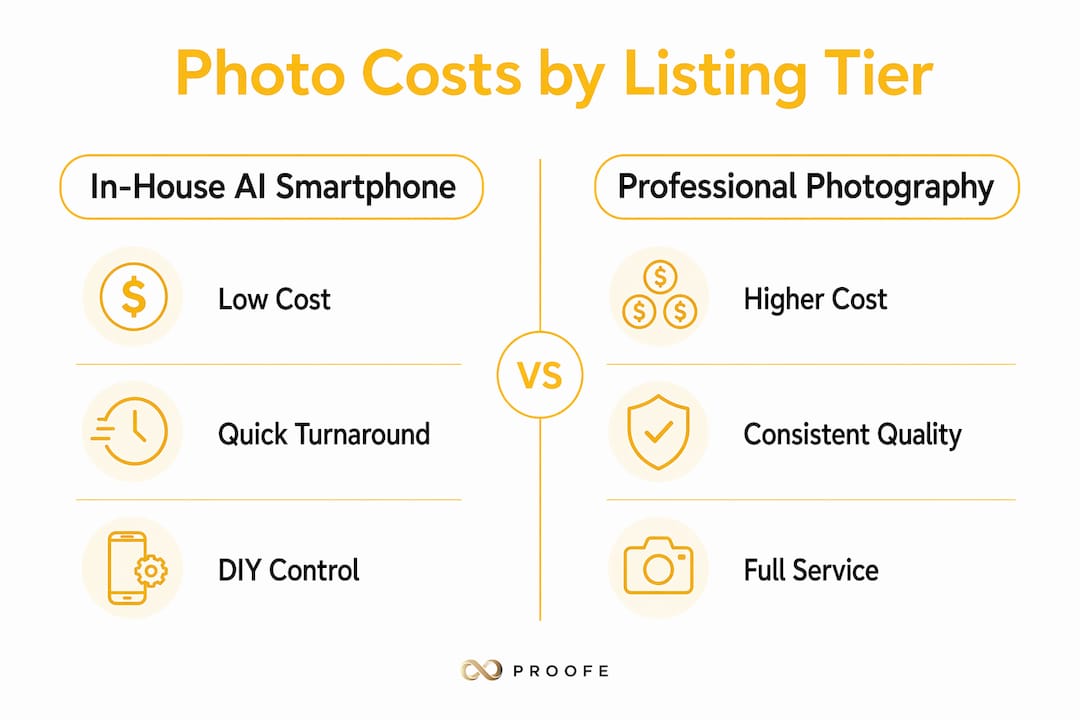
Outsourcing to a professional photographer gives you predictable quality, consistent turnaround, and no equipment overhead. The cost is straightforward: $110–$500 per listing depending on size and market, with add-ons priced separately. For agents doing fewer than five listings a month, outsourcing almost always wins on a pure cost-per-listing basis.
In-house photography, whether that means hiring a staff photographer or using an AI-enhanced smartphone solution, shifts the economics at volume. A staff photographer adds salary, benefits, equipment, and software costs that only make sense if you are producing enough listings to spread that overhead. Most independent agents and small teams never reach that threshold.
The middle path is AI-enhanced smartphone photography. There is no equipment investment beyond a current-generation phone, no scheduling delays, and no per-shoot fee beyond the platform cost. The listing photo editing tools available in 2026 have closed the quality gap for standard and mid-range listings considerably. For luxury properties, outsourcing to a specialist remains the right call, and the ROI supports it.
Proofe cuts your photography costs without cutting quality
Traditional photography services charge $110–$500 per listing before you add drone, video, or virtual staging. For agents managing a steady pipeline, that adds up fast. Proofe gives you a direct alternative: professional listing photos from your smartphone, AI-enhanced and MLS-ready the same day.
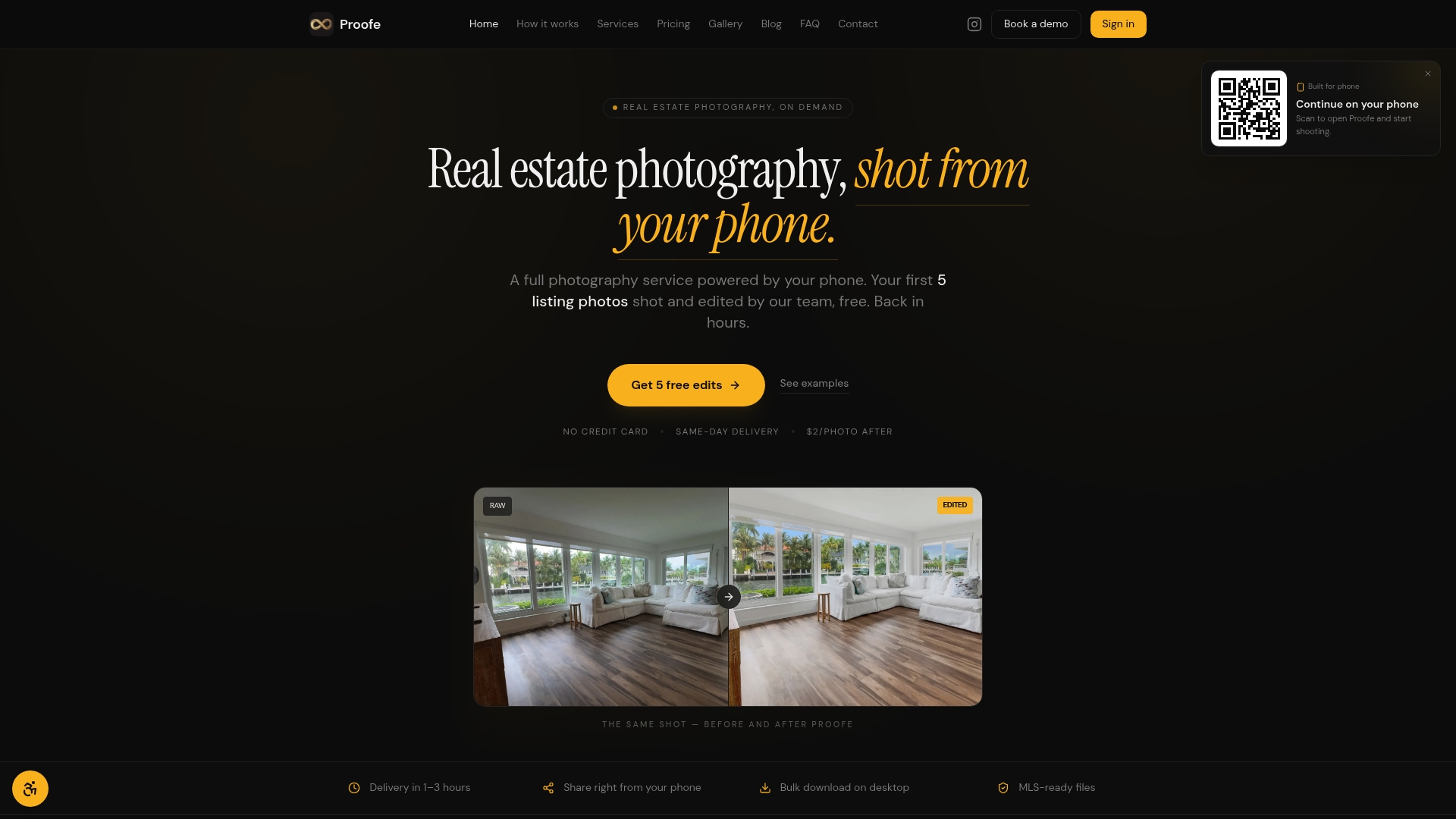
You shoot with the phone you already have. Proofe's AI handles the editing, from lighting correction to sky replacements, and delivers files ready to upload directly to the MLS. No equipment rental, no scheduling a photographer a week out, no waiting 48 hours for edits. The first five photos are free, so you can see the quality before you commit.
Airbnb hosts use Proofe the same way. Refresh your listing photos before peak season in an afternoon, not a week. Better images mean more clicks, more bookings, and stronger nightly rates. See Proofe's pricing and start with your next listing today.
Key Takeaways
Real estate photography costs between $110 and $500 per listing in 2026, and matching that spend to the listing tier is the single most effective way to protect your marketing budget and maximize sale outcomes.
| Point | Details |
|---|---|
| Photography cost range | Standard listings run $110–$500 depending on property size, market, and photographer experience. |
| ROI from quality photos | Homes with professional photos sell up to 47% more per square foot and 32% faster than amateur listings. |
| Volume discount opportunity | Committing to a monthly minimum with one photographer typically reduces per-listing costs by 10–20%. |
| Add-on cost control | Skip twilight shots for standard homes; reserve drone and video for mid-market and luxury listings where ROI is clear. |
| Proofe for cost efficiency | Proofe delivers AI-enhanced, MLS-ready listing photos from your smartphone the same day, with the first five photos free. |